

Quick answer: Signature styles generally fall into a few broad categories, executive/professional scripts, artistic calligraphy, minimalist underlines, monogram or initial-based marks, and playful casual styles. The right one depends less on what looks “nicest” and more on where you’ll actually use it, formal documents, creative branding, or everyday quick signing.
Ask ten people what makes a “good” signature and you’ll get ten different answers. That’s because signature styles aren’t really ranked from best to worst, they’re built for different purposes. A style that’s perfect for a law firm partner would look completely out of place on a photographer’s portfolio site, and vice versa.
Here’s a breakdown of the main categories, what they actually communicate, and how to figure out which one fits you.

Executive and Professional Scripts
This is the style most people picture when they think “business signature.” Clean, moderately slanted, legible without being plain, this category is built for consistency and trust.
Where it works best: Contracts, official correspondence, resumes, professional email sign-offs.
What it communicates: Reliability and professionalism. It’s not trying to be memorable, it’s trying to look the same every time.
Artistic and Calligraphy Styles
Flowing loops, extended tails, and elegant curves define this category. These styles borrow heavily from traditional calligraphy and tend to feel more expressive.
Where it works best: Creative portfolios, personal branding, certificates, wedding-related materials, anywhere personality matters more than strict formality.
What it communicates: Individuality and craftsmanship. The tradeoff is that highly artistic styles can be harder to reproduce quickly and consistently by hand.
Minimalist and Underlined Styles
Simple, often just a first initial and a clean underline or a short stylized mark. This category has grown more popular as digital signatures and minimal branding trends have spread.
Where it works best: Modern brand identities, tech-industry professionals, anyone who wants something fast to sign and easy to read.
What it communicates: Confidence and modernity. A minimal signature can feel intentional in a way a busy one sometimes doesn’t.
Monogram and Initial-Based Marks
Rather than writing out a full name, this style leans on initials, sometimes stacked, circled, or stylized into a small symbol-like mark.
Where it works best: Personal branding, logo-adjacent use cases, situations where a compact, symbolic identifier works better than a full signature.
What it communicates: Distinctiveness. A well-designed monogram is often more recognizable at a glance than a full written name.
Playful and Casual Styles
Rounded letters, softer strokes, sometimes a slight bounce to the baseline. This category feels more relaxed and less formal than the others.
Where it works best: Social media, informal creative projects, personal notes, younger or more casual brand identities.
What it communicates: Approachability. This isn’t the style for a legal document, but it can work well where warmth matters more than formality.
How to Compare Styles for Your Own Name
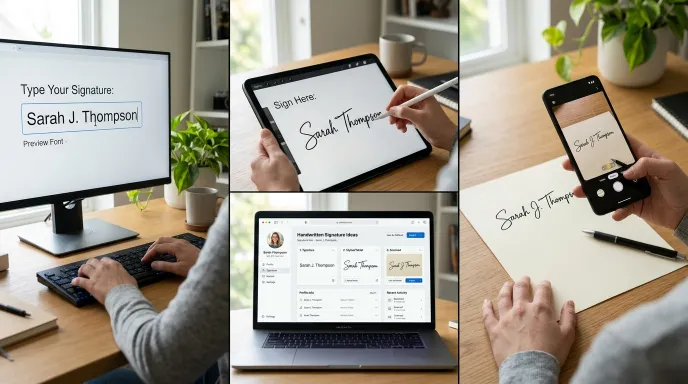
Style categories are a useful starting point, but the same category can look completely different depending on your actual name and letter shapes. A name with tall letters and clear ascenders (like a capital “T” or “L”) tends to suit flowing calligraphy styles well, while shorter, rounder names often look cleaner in a minimalist or monogram style.
The fastest way to actually compare these side by side is to generate a batch across a few categories at once rather than trying to imagine how each would look. The free signature generator lets you do exactly that, pick a style category, generate a set of options, and switch categories to compare how your specific name looks across each one.
Signature Style Comparison at a Glance
| Style Category | Best For | Reproducibility | Overall Feel |
|---|---|---|---|
| Executive / Professional | Documents, business use | High | Reliable, formal |
| Artistic / Calligraphy | Creative branding, certificates | Medium to Low | Expressive, elegant |
| Minimalist / Underlined | Modern brands, quick signing | High | Confident, clean |
| Monogram / Initials | Personal branding, logos | High | Distinctive, symbolic |
| Playful / Casual | Social media, informal use | High | Warm, approachable |
Combining Styles With Regional and Language Preferences
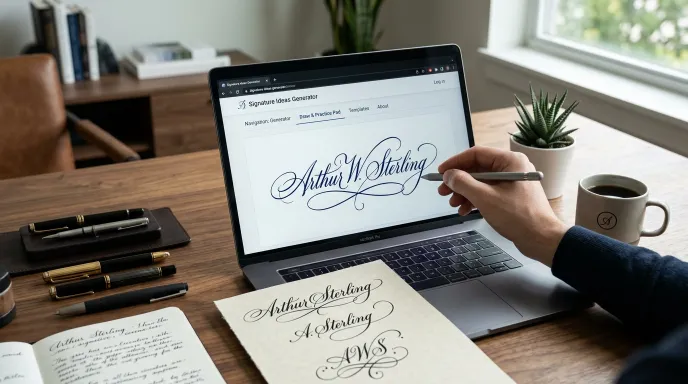
One thing that doesn’t show up in most style guides is how regional and language preferences interact with signature style. A calligraphy-heavy Western script and a Pakistani Nastaliq-influenced flow, for example, communicate a similar “artistic and elegant” feeling but look and read completely differently. If your name or identity connects to a specific language or region, it’s worth exploring style options built around that alongside the more general Western categories, rather than assuming only one visual tradition applies to you. This is one area where generating options genuinely beats guessing, since regional styles carry their own conventions that are hard to approximate by simply modifying a Western template.
Common Mistakes When Picking a Style
- Choosing a style based on someone else’s signature. A style that suits a celebrity’s name or a friend’s handwriting won’t necessarily translate well to your own name’s letter shapes.
- Ignoring the practical context. A gorgeous calligraphy signature designed for a wedding invitation isn’t the right pick for a job application.
- Assuming complexity equals quality. A well-executed minimalist signature often looks more polished than an overly busy one.
- Sticking with only one category during comparison. Style preference is easier to judge when you can compare a few directions side by side rather than evaluating one option in isolation.
How Complexity Level Interacts With Style
Style category isn’t the only variable worth adjusting. Complexity level, ranging from ultra-simple to highly ornamental, changes how any given style actually looks. A calligraphy style at low complexity might just be a gently curved script, while the same category at a high complexity level could involve multiple flourishes and extended tails.
This matters because two people could pick the exact same style category and end up with visually very different signatures, depending on how much complexity they layer on top. If you’re unsure, it’s worth generating the same style at two or three complexity levels before deciding, since the “right” amount of detail is often more about personal comfort with reproducing it than about the category itself. The signature generator lets you adjust both independently, so you’re not locked into one fixed look per category.
Questions People Ask
What are the benefits of using a signature generator? A signature generator lets you compare a wide range of styles quickly, instead of manually sketching and second-guessing one design at a time. It also makes it easy to test how the same name looks across completely different style categories before committing to one.
What is the best free app for creating a signature? Look for a tool that offers a genuine variety of style categories rather than just a handful of fonts, and ideally one that lets you both generate options and draw your own by hand, so you can compare a designed style against your natural handwriting.
Is one signature style objectively better than the others? No. Each style category is suited to different contexts. A style that’s ideal for a formal business document isn’t necessarily the right choice for a creative personal brand, and the reverse is also true.
Can I mix elements from two different styles? Yes. Many people land on a signature that borrows the clean structure of a minimalist style but adds one small flourish, like an underline or a stylized initial, from a more artistic category.
How often do people change their signature style? More often than you’d expect. It’s common to switch styles when starting a new job, launching a personal brand, or simply because an old signature no longer feels representative. There’s no rule limiting you to one style for life.
Does my signature style need to match my personal brand or logo? Not strictly, but there’s an advantage to at least loosely aligning them. A signature that echoes the tone of your broader visual identity, minimal branding paired with a minimal signature, for example, tends to feel more cohesive across everything you put your name on.
The Bottom Line
Signature styles aren’t about finding the single “best” one, they’re about matching the style to the context you’ll actually use it in. Compare a professional script against a more artistic or minimal option using your real name, not just examples, and you’ll usually know which direction fits within a few minutes.
Ready to see how your name looks across different categories? Try the free signature generator and generate a batch across a few style directions to compare directly.
For more free tools to build out your full brand identity, browse the complete Business Naming & Branding Tools collection, or head straight to the signature generator to get started.
Written by Waseem Aijaz, WordPress Developer and SEO Specialist. Connect on LinkedIn.