Quick answer: Choose a domain that matches your brand name, is short, and is easy to say and spell, with no hyphens or numbers. Pick a .com if you can, or a country domain such as .co.uk if you mainly serve one country. The extension won’t help you rank, because Google treats new generic extensions like .com. Register the domain and the matching social handles before you announce the name. The nine rules below explain why, and how to apply them.
What a good business domain does
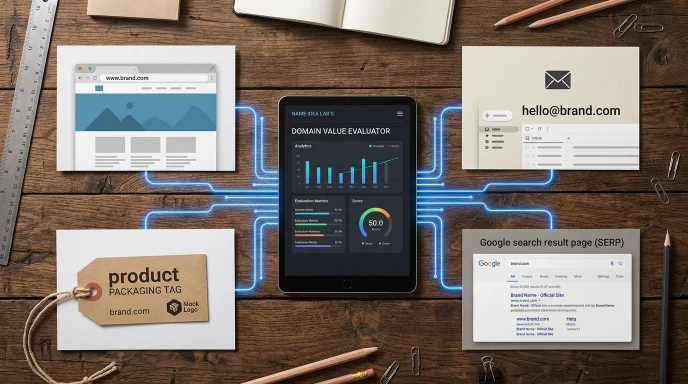
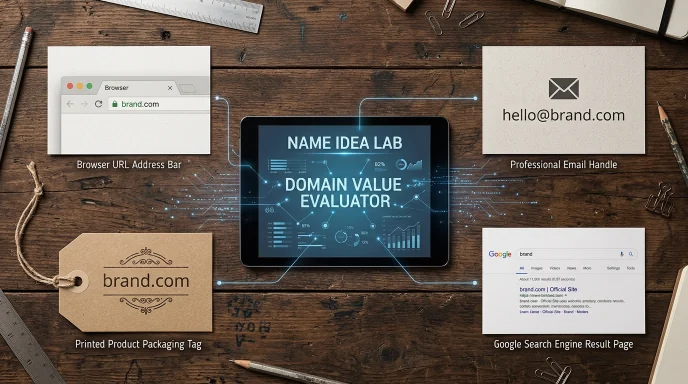
A domain does four jobs at once. It’s the address people type, the ending of your email, the line printed on your packaging, and the first thing many customers see in a search result. A weak domain makes all four harder. A strong one is easy to remember and costs you nothing to explain.
The nine rules
1. Match your brand name
The best domain is your brand name, spelled the way people hear it. If you’re called Willow & Vine, willowandvine.com is ideal. When the exact name is taken, you have three choices: pick another name, add a short word that makes sense (shop, studio, hq), or use a different extension. Be wary of anything that turns your name into something customers have to decode. If you’re still choosing the name itself, start with our guide to how to name your business.
2. Keep it short and easy to say
Aim for 15 characters or fewer. Say the domain aloud to someone and ask them to type it. If they get it wrong, so will your customers. Short domains also fit better on signs, business cards and social profiles.
3. Avoid hyphens, numbers and tricky spellings
Hyphens are easy to forget and awkward to say (“my dash brand dash shop”). Numbers cause confusion over whether to write “4” or “four”. Swapping letters for look-alikes, like “kreative”, means people mistype the address and land on a competitor.
4. Choose the extension for your audience
The part after the dot is called the top-level domain, and there are three common choices.
- .com: the one most people try first. A good default if you’ll sell to customers in several countries.
- A country domain (.co.uk, .ca, .com.au): it signals that you serve one country, and Google treats most country domains as a hint about the country you target. That can help a local business.
- A newer extension (.shop, .store, .studio): fine for branding, but Google has said it treats new generic extensions like .com and that keywords in an extension give no ranking advantage. Some country extensions, such as .io and .ai, are treated as generic too, so check Google’s current list before you rely on one.
For the details, read Google’s own post on how it handles new top-level domains.
5. Don’t expect keywords in the domain to rank you
A domain full of search phrases doesn’t give you a shortcut. Content, links and a trusted brand do most of the work. A name people can remember, search for and recommend is worth more than one that tries to describe everything you sell.
6. Make sure it isn’t someone else’s brand
A free domain only tells you nobody has registered that web address. It doesn’t tell you that nobody has rights in the name. Search the trademark register for your country, such as the USPTO in the US or the UK trade mark search, before you buy. Avoid names that look too much like a famous brand.
7. Think about the email address
Your domain is part of every email you send. Say the full address aloud, for example hello@yourbrand.com. Check where the words join, since two words side by side can accidentally spell something you didn’t intend.
8. Protect it
- Turn on auto-renewal and keep your contact details current, so you don’t lose the domain by accident.
- Register the .com as well as your local extension if you can, so a competitor can’t take the other one.
- Buy a common misspelling only if your brand name is often mistyped. Don’t buy dozens of variations.
- Check the domain on a lookup tool such as ICANN Lookup to see who owns it and whether it’s in use.
9. Test it before you pay
Text it to a friend and ask what they think the business does, then look at it in lowercase on a phone. Then match it against the handles you’ll use. If your first choice of handle is taken, our Social Media Name Generator can suggest close alternatives.
A simple scorecard
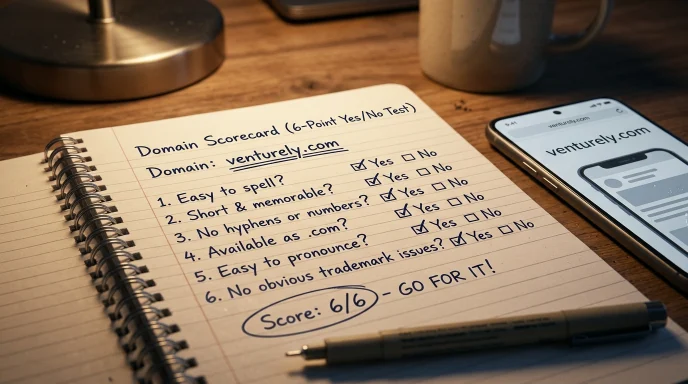
Give each candidate a point for every yes:
- Does it match your brand name?
- Is it 15 characters or fewer?
- Is it free of hyphens, numbers and odd spellings?
- Is the extension right for your audience?
- Is the matching social handle free?
- Is there no trademark clash?
Six out of six is a keeper. Four or fewer means keep looking.
Common mistakes
- Buying the domain before checking the name’s availability elsewhere. A domain doesn’t give you trademark rights.
- Choosing a keyword-heavy domain that doesn’t match your brand. It’s hard to build recognition around it.
- Using a hyphen to get around a taken name.
- Forgetting to renew. An expired domain can be registered by someone else.
- Picking a domain you’ll want to change soon. Moving later is possible, but it takes planning. Our guide to renaming a business without losing your Google rankings explains how.
Domain name FAQs
Does the extension affect my SEO?
Not directly. Google says it treats new generic extensions like .com and that keywords in an extension give no ranking advantage. Country extensions can act as a hint about the country you target. Most people still try .com first, which can help with trust and recall.
Should I use a hyphen if the name I want is taken?
It’s usually better not to. Hyphens are easy to forget and hard to say aloud. Consider a different name, or a short extra word, instead.
What if the .com is taken?
Check whether it’s in use. If it isn’t, you could ask the owner, though you can’t count on a reply. Otherwise choose a different name, add a short relevant word, or use a country extension if you mainly serve one country. Don’t pick a domain that is almost the same as an active business’s, because that can cause confusion and legal trouble.
Do I need a domain before I register my business?
No. Registering a domain and registering a business are separate. But buying the domain early is cheap protection once you’ve settled on the name.
This is general information, not legal advice. Trademark and company-name rules differ by country, so use the official links above and ask a qualified professional if you’re unsure.
About the author: Waseem Aijaz is a WordPress developer and SEO specialist who built the free naming tools on Name Idea Lab. Read more about Name Idea Lab.