
Quick Answer: Many Indian surnames historically developed alongside caste and community identity, often originating from an occupation, a regional title, or a religious role tied to a specific community. This guide looks at that history factually and neutrally, focusing on where these surnames came from linguistically and historically.
Surnames in India often carry more historical information than people realize — many developed over centuries alongside regional, occupational, and community identity, including caste. This guide looks at that history the way a genealogist or linguist would: focused on documented origin, not judgment.
Why Caste and Surnames Became Linked Historically
In much of pre-modern India, occupation, community, and social status were closely tied together, and surnames often developed as identifiers of that combined identity — similar to how many European surnames trace back to a trade (Smith, Baker) or a place (Hill, Ford). Over generations, some of these occupation- or community-linked names became formalized as hereditary surnames, carried forward regardless of whether a family still practiced the original associated occupation.
It’s worth noting upfront: a surname today tells you very little about an individual beyond a historical naming pattern. Modern India’s constitution explicitly prohibits caste-based discrimination, and reducing any person to a historical surname association misses the reality of how identity, profession, and community have evolved over generations.
Surnames Historically Associated With Brahmin Communities
Brahmin-associated surnames often trace back to a region, a Vedic school of study, or a specific priestly role.
| Surname | Region | Origin Note |
|---|---|---|
| Sharma | North India | Derived from a Sanskrit word meaning “protection, joy” |
| Iyer | Tamil Nadu | Associated with Tamil Brahmin communities |
| Iyengar | Tamil Nadu | A specific Vaishnavite Brahmin community identifier |
| Bhattacharya | Bengal | Meaning “great scholar,” tied to Bengali Brahmin lineage |
| Trivedi | North/West India | Meaning “one who knows the three Vedas” |
Surnames Historically Associated With Kshatriya (Warrior/Ruling) Communities
These surnames often trace back to ruling clans, warrior lineages, or martial titles.
| Surname | Region | Origin Note |
|---|---|---|
| Singh | North India, Punjab | Meaning “lion,” widely used across Rajput and Sikh communities |
| Rajput | North/West India | A direct community identifier tied to historical warrior clans |
| Chauhan | Rajasthan | Tied to a specific historical Rajput dynasty |
| Rana | Rajasthan/Himalayan region | Historically a title for ruling chiefs |
Surnames Historically Associated With Merchant and Trading Communities
Many well-known Indian surnames trace back to trading and merchant castes.
| Surname | Region | Origin Note |
|---|---|---|
| Agarwal | North India | Tied to a historically prominent trading community |
| Gupta | North India | Meaning “protected,” historically associated with merchant and administrative roles |
| Jain | Pan-India | A direct religious and community identifier tied to Jainism |
| Shah | Gujarat/West India | Meaning “king” or “merchant,” widely used among trading families |
Occupational Surnames Tied to Specific Trades
Some surnames directly describe a historical trade, independent of broader caste categorization.
| Surname | Meaning |
|---|---|
| Patel | Village headman or landholder |
| Vaidya | Physician, practitioner of traditional medicine |
| Sonar | Goldsmith |
| Lohar | Blacksmith |
Regional Variation in Caste-Associated Surnames
The same broad community can carry different surnames depending on the region — a Brahmin family in Bengal might carry “Chatterjee” or “Bhattacharya,” while a Brahmin family in Tamil Nadu might carry “Iyer” or “Iyengar,” and one in North India might carry “Sharma” or “Trivedi.” This regional variation is a strong reminder that “caste” and “surname” aren’t a single national system — they developed differently across India’s many linguistic regions.
Why This History Matters for Naming Today
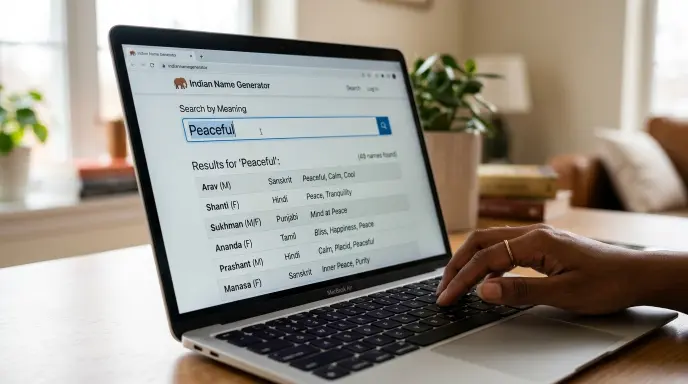
Understanding a surname’s historical background is useful for genealogy, cultural research, or simply satisfying curiosity about your own family name — not for making assumptions about individuals today. If you’re pairing a surname with a first name, whether for a newborn or a creative project, the Indian Name Generator lets you attach any surname directly to a generated name and preview the complete result.

Common Mistakes to Avoid
- Assuming a surname tells you everything about a person’s background today. Surnames reflect historical naming patterns, not a fixed marker of an individual’s current identity or status.
- Treating caste-associated surnames as uniform nationally. The same broad community carries entirely different surnames depending on the region.
- Overlooking that many people share a surname without a shared caste background. Especially with occupational or title-based surnames, unrelated families across different backgrounds can carry the same name.
- Ignoring the legal and social context. Caste-based discrimination is prohibited under Indian law, and surname history should be approached as genealogical information, not a basis for assumption.
Frequently Asked Questions
What are the top 100 Hindu surnames? A full ranked list varies by source and region, but widely recognized Hindu surnames include Sharma, Verma, Gupta, Iyer, Reddy, Patel, and Chauhan, spanning multiple regional and community origins.
Which surname is top in India? There’s no single nationally dominant surname — prevalence varies heavily by state, with Sharma and Verma common in the North, Reddy and Naidu common in the South, and Patel especially prevalent in Gujarat.
What are uncommon Indian surnames? Surnames tied to small, specific regional or occupational communities — rather than widely used names like Sharma or Patel — tend to be rarer nationally, even if well recognized within their local region.
Does a surname always indicate someone’s caste today? Historically, many surnames were linked to caste and occupation, but a surname alone doesn’t reliably indicate an individual’s current identity, profession, or social standing.
Can I generate a name with any surname attached, regardless of category? Yes, the Indian Name Generator lets you attach any surname or father’s name you choose to a generated first name.
Are caste-associated surnames the same across all of India? No, the same broad community can carry entirely different surnames depending on the region — a strong reminder that surname history in India developed differently across its many linguistic areas.
Conclusion
Many Indian surnames carry a documented historical connection to region, occupation, and community, including caste — information that’s genuinely useful for genealogy and cultural understanding, but not a basis for judging any individual today. Understanding this history in its proper historical and regional context provides real insight that a plain surname list never offers. The Indian Name Generator lets you pair any surname with a generated name directly, and the broader Culture & Religion Name Generators hub covers naming traditions from other countries as well.
Disclaimer: This content is provided for general historical and genealogical informational purposes only, based on documented linguistic and regional sources. It does not reflect any judgment about individuals or communities. Caste-based discrimination is prohibited under Indian law, and readers are encouraged to approach this history with that context in mind.