
Quick Answer: Indian surnames generally trace back to one of four sources — region or place of origin, occupation or profession, a religious or community identifier, or a title that became hereditary over generations. Understanding which category a surname falls into explains not just what it means, but why certain surnames cluster in certain parts of India.
A first name usually gets chosen with care. A surname is almost always inherited, and most people never stop to learn where it actually comes from. This guide breaks down the real origins behind common Indian surnames, drawing on the same patterns genealogists and linguists actually use to trace them.
The Four Main Categories of Indian Surnames
1. Regional and Place-Based Surnames
Many Indian surnames identify a family’s historical village, town, or region of origin.
| Surname | Region / Meaning |
|---|---|
| Chatterjee | Bengali; derived from a village name, common among Bengali Brahmins |
| Iyer | South Indian (Tamil); a Brahmin community identifier |
| Rana | Rajasthani/Himalayan; historically tied to ruling clans |
| Naidu | Telugu/South Indian; a title-derived community surname |
2. Occupational Surnames
Some surnames describe a family’s historical trade or profession, similar to how “Smith” or “Baker” work in English.
| Surname | Meaning / Origin |
|---|---|
| Patel | Historically tied to village headmen or landholders in Gujarat |
| Shah | Meaning “king” or “merchant,” widely used among trading communities |
| Vaidya | Meaning “physician,” tied to traditional Ayurvedic medicine practice |
| Kamath | Tied to accounting or record-keeping roles historically |
3. Religious and Community-Based Surnames
Certain surnames function as direct identifiers of religious or community background.
| Surname | Community / Meaning |
|---|---|
| Singh | Meaning “lion,” used widely by Sikh families and also common among Rajputs |
| Khan | A title of Central Asian origin, used among many Indian Muslim families |
| D’Souza | A Portuguese-derived surname common among Indian Christian families, especially in Goa |
| Kaur | Meaning “princess,” used as a surname/middle name for Sikh women |
4. Title-Based and Hereditary Surnames
Some surnames began as honorary titles granted for service or status, which later became fixed family names.
| Surname | Meaning / Origin |
|---|---|
| Rao | A title historically granted to regional rulers or officials, later used as a surname across several states |
| Chowdhury | A title for a local revenue collector or community leader, now a widespread surname |
| Bahadur | Meaning “brave, valorous,” originally a title of honor |
Why the Same Surname Can Mean Different Things in Different States
A surname like “Rao” appears across Andhra Pradesh, Karnataka, and Maharashtra, but doesn’t always trace back to one single lineage — it was historically a title granted independently across regions, later adopted as a surname by many unrelated families. This is different from a tightly regional surname like “Iyer,” which is specifically tied to a Tamil Brahmin community and carries a much narrower geographic and community association.
How Surnames Pair With Given Names in Practice
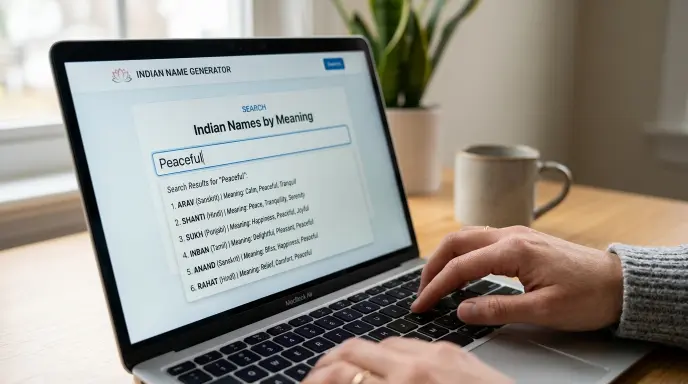
Understanding a surname’s background is useful on its own, but most people are actually choosing or confirming a surname alongside a given name — exactly the gap the Indian Name Generator is built to fill. Instead of separately researching a surname and guessing how it reads with a chosen first name, the tool lets you enter a father’s name or surname directly, attach it as a prefix or suffix, and preview the complete result instantly.
Where People Go Wrong
- Assuming every surname has one single, fixed meaning. Many, like Rao or Chowdhury, were titles first and surnames second — their “meaning” reflects a historical role, not a literal translation.
- Confusing a regional surname with a religious one. Singh (Sikh and Rajput) and Khan (Muslim) both carry strong community associations, but for very different historical reasons.
- Ignoring spelling variation across regions. The same surname can appear as Chatterjee, Chatterji, or Chattopadhyay depending on regional transliteration.
- Assuming a shared surname always means a shared family line. Especially with title-based surnames like Rao or Shah, unrelated families across different states often share the same surname.
Quick Reference: Indian Surnames by Category
| Category | Examples |
|---|---|
| Regional | Iyer, Naidu, Chatterjee, Rana |
| Occupational | Patel, Shah, Vaidya, Kamath |
| Religious/Community | Singh, Khan, D’Souza, Kaur |
| Title-Based | Rao, Chowdhury, Bahadur |
Questions People Ask
What is a common Indian last name? Surnames like Sharma, Patel, Singh, and Kumar are among the most widely used across India, each tied to different regional, occupational, or community origins.
What are the top surnames in India? Common surnames vary heavily by region — Sharma and Verma are widespread in North India, while Reddy and Naidu are common in the South, and Patel is especially prevalent in Gujarat.
Which surname is rare in India? Highly region- or community-specific surnames tied to small historical communities tend to be rarer nationally, even if well known within their specific region.
What do most Indian surnames actually mean? Most trace back to a region, an occupation, a religious or community identity, or a hereditary title — rarely a random label.
Can I see how a surname looks paired with different first names? Yes, the Indian Name Generator lets you enter any surname or father’s name and preview it instantly against generated first names.
Are Indian surnames always tied to a specific religion? No. Many surnames, particularly occupational and title-based ones, are used across multiple religious communities, while others (like Kaur or Khan) are more specifically tied to one.
Final Thoughts
Most Indian surnames trace back to a region, an occupation, a religious or community identity, or a title — rarely a random label. Knowing which category your own surname falls into (or the one you’re considering pairing with a new name) adds real context that a plain name list never gives you. To see exactly how a surname reads with different first names, the Indian Name Generator handles that pairing directly, and the wider Culture & Religion Name Generators hub covers surname and naming traditions from other countries as well.
Disclaimer: Surname origins and meanings are provided for general informational purposes based on documented historical and linguistic sources. Family-specific lineage can vary, so significant naming decisions should be confirmed with a trusted family or community source.