
Quick Answer: Arabic girl names generally draw from four sources — Quranic names, names of historically significant women in early Islamic history, Classical Arabic meanings tied to nature or virtue, and modern regional names in current use across the Arab world. This guide breaks down real examples from each group, with meanings, plus a free tool to generate more.
Search “Arabic girl names” and most lists blend everything into one undifferentiated pile — Quranic names next to modern coinages, with no explanation of where any of them actually come from. This guide organizes Arabic girl names by origin, so you can search with intention instead of scrolling blind.
Quranic and Religiously Significant Names
These names carry the deepest historical and religious weight, appearing directly in the Quran or tied closely to early Islamic history.
| Name | Meaning | Significance |
|---|---|---|
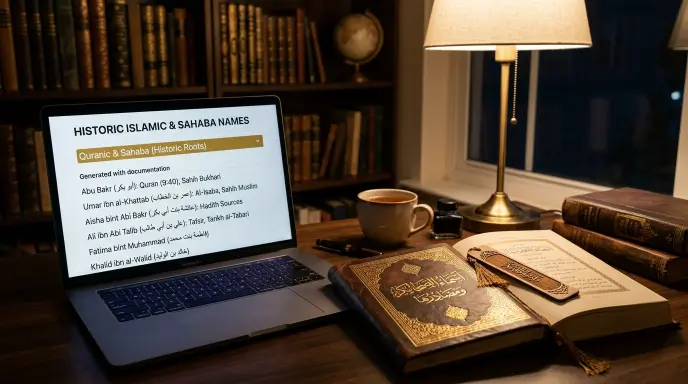
| Maryam | Beloved, one who is chosen | Appears in the Quran; the mother of Prophet Isa (Jesus) |
| Khadija | Premature child, trustworthy | The Prophet Muhammad’s first wife |
| Aisha | Alive, living | A wife of the Prophet, known for her scholarship |
| Fatima | One who abstains | The Prophet’s daughter |
| Zainab | Fragrant flower | Carried by several significant women in early Islamic history |
Classical Arabic Names Tied to Nature and Virtue
Classical Arabic naming leans heavily on nature imagery and virtue, giving these names a poetic, timeless quality.
- Noor — meaning “light”
- Layla — meaning “night,” often associated with beauty and mystery
- Yasmin — meaning “jasmine flower”
- Amal — meaning “hope”
- Sabra — meaning “patience”
These names tend to translate cleanly and clearly, making their meaning immediately understandable across languages.
Names With Especially Strong Meanings
If meaning matters more to you than familiarity, a few names stand out for how directly they translate.
- Rahma — meaning “mercy”
- Karima — meaning “generous, noble”
- Safiya — meaning “pure, chosen friend”
- Hakima — meaning “wise”
Modern and Regionally Popular Names
A newer wave of Arabic girl names has grown popular across the Arab world, often blending classical roots with a softer, more contemporary sound.
- Lana — meaning “tender, soft”
- Rania — meaning “queenly, gazer”
- Sara — meaning “princess, noble woman”
- Dana — meaning “wisdom” or “precious,” depending on regional usage
- Lujain — meaning “silver,” a name that’s grown in popularity in recent years
These names are widely used across Saudi Arabia, the UAE, Egypt, Jordan, and other Arab countries, with some regional variation in popularity.
Unique and Less Common Names
Names built from less frequently used roots, or names with especially specific meanings, tend to stand out as more distinctive.
- Munira — meaning “illuminating, radiant”
- Basma — meaning “smile”
- Aziza — meaning “cherished, powerful”
- Ghaida — meaning “delicate, graceful”
How to Choose the Right One
- Decide if religious significance matters to you. A Quranic name and a purely Classical Arabic nature-based name carry very different weight — knowing which you want narrows the search fast.
- Check the meaning across sources. Some names carry slightly different interpretations depending on regional or scholarly source — worth confirming if the meaning matters deeply.
- Consider regional popularity if relevant. Some names are more common in the Gulf region, while others are more typical in the Levant or North Africa.
- Say the name with a family name if one applies. Testing the full combination matters before finalizing, especially with Arabic naming structures that often include a father’s name.
What Trips People Up
- Assuming every Arabic name is religious. Many beautiful, widely used Arabic names come from Classical Arabic nature and virtue vocabulary with no direct religious tie.
- Overlooking regional spelling variation. The same name can be transliterated multiple ways (Aisha/Ayesha, Zainab/Zeynep) depending on region and dialect.
- Assuming Arabic names apply to only one country. Arabic naming traditions are shared across the entire Arabic-speaking world, from Morocco to Iraq to the Gulf states.
- Skipping the meaning check on beautiful-sounding names. Not every elegant-sounding name has an equally elegant or appropriate meaning — always verify.
Quick Answers to Common Questions
What is the prettiest name in Arabic? This is subjective, but names like Layla, Yasmin, and Noor are frequently cited as especially beautiful due to both their sound and their nature-based meanings.
What are unique Arabic names for girls? Names like Munira (illuminating), Ghaida (delicate), and Aziza (cherished) stand out as less commonly used while still carrying strong, clear meanings.
Are there Arabic girl names from the Quran? Yes, names like Maryam and several names tied to significant women in early Islamic history appear in or are closely connected to the Quran.
What is a modern Arabic name for a girl? Names like Lana, Rania, and Lujain reflect current naming trends across the Arab world, blending classical roots with a softer, contemporary sound.
What name means blessing in Arabic? Names like Baraka (from the root meaning “blessing”) and Ni’ma (meaning “blessing” or “grace”) are commonly associated with this meaning.
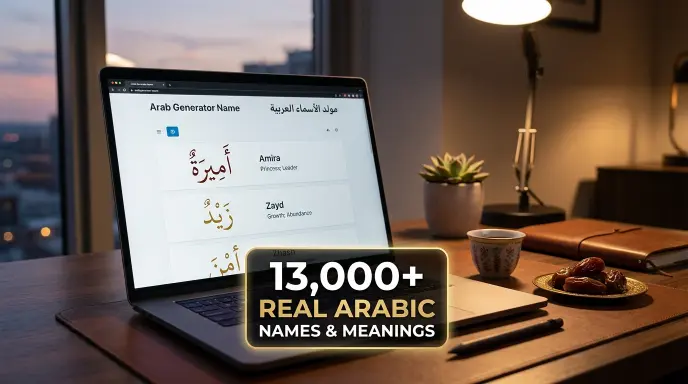
Can I generate more Arabic girl names filtered by category? Yes, the Arabic Name Generator lets you filter by category and gender, and even attach a family name to preview the complete result.
Wrapping Up
The best Arabic girl name usually comes down to which tradition — Quranic, Classical Arabic, or modern regional — actually reflects what you’re looking for. Understanding where a name comes from makes the choice far more intentional than picking by sound alone. For hundreds more options across every category covered here, the Arabic Name Generator covers the full range in one place, and the broader Culture & Religion Name Generators hub covers other countries and cultures as well.