
Quick Answer: Traditional Arabic naming isn’t built around a single fixed “last name” the way Western naming is. Instead, it’s built from several components — a given name, a father’s name (nasab), sometimes a nickname referencing a child (kunya), and a tribal or place-based identifier (nisba). Modern usage has simplified this into more Western-style surnames in many countries, but understanding the traditional structure explains a lot about how Arab names actually function.
Search “Arabic last names” and you’ll mostly get flat lists of surnames with no explanation of how they actually fit into a full Arab name. That’s a real gap, because traditional Arabic naming doesn’t work like a simple first-name-plus-surname system — it’s built from several distinct components, each carrying its own meaning and function.

The Traditional Components of an Arabic Name
Ism (Given Name)
This is the personal, given name — Muhammad, Fatima, Khalid, and so on. It’s chosen at birth and functions similarly to a Western first name.
Nasab (Father’s Name / Lineage)
The nasab traces lineage through the father’s line, using “ibn” (son of) or “bint” (daughter of). A name like Ali ibn Abi Talib means “Ali, son of Abu Talib.” This component can extend several generations back in formal or historical contexts, tracing an entire family line.
Kunya (Teknonym)
A kunya is a nickname referencing someone’s child, using “Abu” (father of) or “Umm” (mother of). Abu Bakr, for example, means “father of Bakr.” This naming convention is used as a sign of respect and is sometimes used even before a person actually has children, functioning more as an honorific.
Nisba (Tribal or Place-Based Identifier)
A nisba identifies a person’s tribe, region, or place of origin, typically ending in “-i” or “-iyya.” Al-Baghdadi means “from Baghdad.” Al-Qurashi identifies someone from the Quraysh tribe. This component functions closest to what a modern surname does.
Laqab (Honorific or Descriptive Title)
A laqab is an honorific or descriptive nickname, sometimes based on a notable trait or achievement — similar in function to a title or epithet added to a name.
How This Compares to Modern Arabic Surnames
| Traditional Component | Function | Modern Equivalent |
|---|---|---|
| Ism | Given name | First name |
| Nasab | Father’s lineage | Middle name / patronymic |
| Kunya | Teknonym (child-referencing) | Honorific nickname |
| Nisba | Tribal/place identifier | Closest to a surname |
| Laqab | Descriptive title | Rare in modern daily use |
Most modern Arab countries today use a simplified, more Western-style system — a given name plus a family surname that’s passed down generationally, similar to surname systems elsewhere. But that modern surname often has roots in one of these traditional components, particularly the nisba (tribal/place name).
Common Modern Arabic Surnames and Their Origins
- Al-Rashid — derived from “rashid” (rightly guided), often tribal or honorific in origin
- Al-Farsi — meaning “the Persian,” a nisba indicating Persian origin within the Arab world
- Hassan — used as both a given name and a surname in many families, derived from “beautiful, good”
- Khoury — meaning “priest,” an occupational surname common among Arab Christian families
- Nasser — meaning “victorious, helper,” used widely as both a given and family name
Why This Structure Matters
Understanding these components explains a lot that a flat surname list can’t. It explains why the same “surname” might actually be a tribal identifier shared by thousands of unrelated families, why some Arab public figures are known by a kunya rather than their given name, and why historical Arabic names can look so much longer and more complex than a modern Western name.
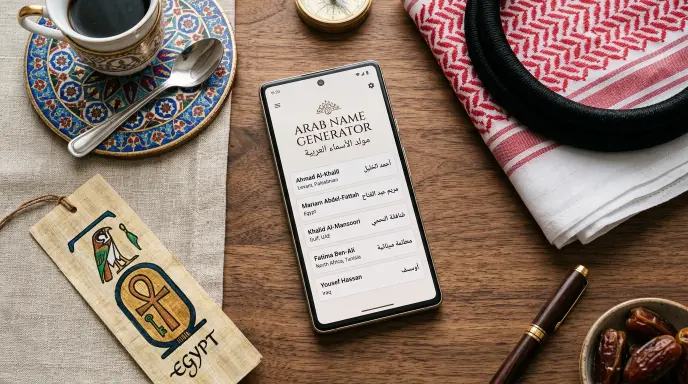
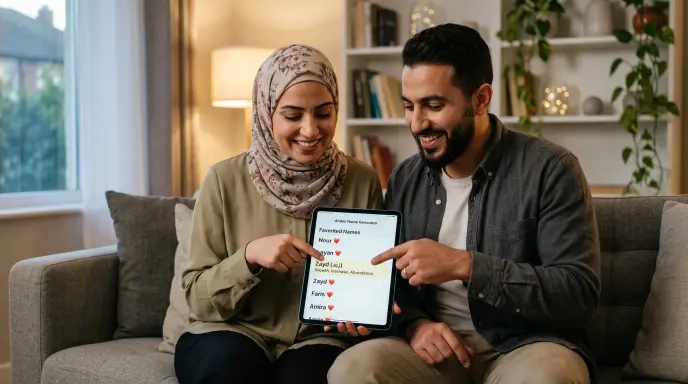
This structural understanding also matters when pairing a first name with a family name — exactly what the Arabic Name Generator is built to handle, letting you enter any surname or father’s name and preview the complete combination instantly.
Where People Go Wrong
- Assuming every Arabic name follows the Western first-name/last-name pattern exactly. Traditional structure is more layered, even though many modern countries have simplified toward a Western-style system.
- Confusing a kunya with a given name. “Abu Bakr” and similar names function as honorific nicknames, not simply personal given names.
- Assuming a shared nisba means a shared family line. A nisba often indicates a shared tribe or region, not necessarily close family relation.
- Ignoring regional variation. Naming customs and surname usage differ across the Gulf, Levant, North Africa, and other Arab regions.
Questions People Ask
What is a typical Arab last name? Modern Arab surnames often derive from a tribal identifier (nisba), an occupation, or a father’s name passed down generationally — examples include Al-Rashid, Nasser, and Khoury.
What does “ibn” or “bin” mean in an Arabic name? “Ibn” or “bin” means “son of,” used to trace lineage through the father’s line, as in “Khalid ibn Walid” (Khalid, son of Walid).
What is a kunya in Arabic naming? A kunya is a nickname referencing a person’s child, using “Abu” (father of) or “Umm” (mother of), often used as a sign of respect.
How are Arabic names structured overall? Traditional Arabic names can include a given name (ism), a father’s lineage (nasab), a teknonym (kunya), a tribal or place identifier (nisba), and sometimes an honorific title (laqab), though modern usage often simplifies this to a given name and surname.
Is “Al-” part of an Arabic surname significant? Yes, “Al-” generally functions as “the” and often precedes a nisba (tribal or place-based identifier), such as Al-Baghdadi (“the one from Baghdad”).
Can I attach a surname to a generated Arabic first name? Yes, the Arabic Name Generator includes a surname or father’s-name field, letting you preview the complete name in the order you choose.
Final Thoughts
Arabic last names aren’t a simple, single-word system — they’re the modern simplification of a much richer traditional structure built from lineage, teknonyms, tribal identity, and honorific titles. Understanding that structure gives real context that a plain surname list never provides. The Arabic Name Generator handles the name-and-surname pairing directly, letting you preview a full name instantly, and the broader Culture & Religion Name Generators hub covers naming traditions from other countries and cultures as well.
Disclaimer: Naming structure and surname origins are provided for general informational purposes based on documented linguistic and historical sources. Specific family or tribal history should be confirmed with a knowledgeable source.